






Protecting people, work-in-progress and equipment
Machine designers and manufacturers have an awesome responsibility: keep operators safe and keep production flowing. In increasingly automated environments, maintaining safety and productivity is more challenging than ever before. Machines now operate autonomously, humans work side-by-side with robots, and complex systems have a large number of safety-related I/O points. The growing use and complexity of automation explains why so many of our customers are opting to integrate control and safety. Supply chain gaps and employee protection have accelerated industry-wide efforts to automate more and more production processes.
Pervasive automation requires an even greater focus on safety for workers who interface with and control automated systems. The more complex the automation is, the more challenging the safety becomes. Thanks to advances in technology, however, companies can now integrate machine control and safety on one platform, transport control and safety over one network, and program both within one software environment. Integrating control and safety onto the same network:
- Enables engineers to assess risk and define functional safety requirements early in the design process to achieve a higher level of safety
- Improves machine communication because equipment control and safety are both handled in one programming environment
- Makes it possible for control software to monitor each line component in real-time
Instead of simple “go” or “no go” controls, operators have more sophisticated safety controls that allow them to respond to problems in a more intelligent way. They can segment or separate discrete parts of the process. For example, if one part of the process is having an issue, rather than shutting the whole machine down in an uncontrolled way, operators can bring the problem section to a stop with a predefined safe speed. This allows for quicker machine startup once the problem is fixed and reduces wear and tear on the mechanical system. Operators can also adjust other sections of the process individually, commanding upstream and downstream machines to continue as normal, slow down, or idle to create or clear backlog.
This more granular control reduces the impact of a single-down machine on the overall process. In addition, since all components are on the same network, operators can easily pull detailed status/alarm data from devices. This data can be sent to the HMI, SCADA, BMS, or even an email to the maintenance team to reduce downtime further. Of course, there will always be a place for traditional standalone e-stop and safety relay circuits. However, in highly automated environments, integrated control and safety are the future of machine design.
It keeps operators safe, which should always be the main concern. It also keeps machines safe. Machines that can run in a safe state, even during normal operation, can be protected from mechanical or electrical damage. This is no small thing.
Ongoing value beyond safety
In addition to preventing machines from being damaged or destroyed, integrated safety and control also reduces scrap, saves floor space and streamlines engineering Integrating control and safety also increases overall productivity. Designing safety into machines improves:
- Machine uptime, because there’s no need to power off and then power up the machine when it’s in a safe state
- Troubleshooting, because control and safety data travel on the same network, awareness of the entire system is enhanced and more advanced diagnostics are possible
- Management, because the same software is used for all, ongoing maintenance is significantly easier
Finally, when safety travels on the network, valuable data can be collected, analyzed, and used to provide a safer and more efficient environment. There is no data when you hard wire safety. Rather than something that is added once equipment is in place, safety is built into every component during machine design. 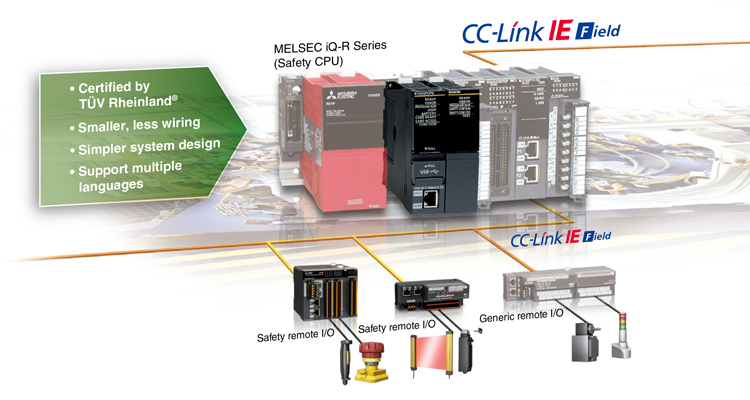
Safety by design
When it comes to machine design, safety shouldn’t be an afterthought. It should not be something that is added once the production equipment is in place. Rather, comprehensive safety should be built into every component from the beginning to reduce risk upfront and avoid accidents and litigation later. Smarter, connected components with improved processing power and advanced communication capabilities can create more intelligent systems that allow you to attain ongoing safety and productivity. What should a total safety solution include? Look for an integrated safety controller that delivers functionally safe machines on one platform, over one network, using one software, while maintaining functional separation between control and safety.
Even though there are independent controllers for process and safety control, both should:
- Sit on the same platform
- Share the same core components
- Be programmed with the same software
- Travel on the same network and
- Communicate with each other through a shared high-speed data bus that is tightly synchronized and not affected by I/O and network traffic
- There should be no wiring or gateways between the two controllers, so there are no unnecessary points of failure.
When the main process and safety functions are physically separated at the controller level but integrated at the network level, information can be shared for greater visibility and rapid problem resolution.
