This article discusses blocking distance and what happens when sensors become submerged. Submersion (or flooding) of the sensors can occur in some applications, so ultrasonic level measurement sensors are therefore often protected by mechanical flooding sleeves. However, such components can easily become contaminated and impair the reliability of the measurement. Radar level measurement sensors, on the other hand, have no dead zone, do not require protective sleeves, and measure reliably even in the case of submersion. There are many containers that hold aggressive media such as acids or alkalis.
Reliable measurement—right up to the antenna—is important here, such as for a chemical container filled with iron chloride, for example. The problem with ultrasonic flowmeters for such an application is that the sound transducer is a loudspeaker and microphone in one. While transmitting signals, it cannot receive any signals. This creates a blocking distance. Ultrasonic, therefore, is not necessarily suitable for applications where there is a high chance of overflowing.
We do not have this problem with radar sensors. A radar sensor can simultaneously emit and receive signals. This means there is no blocking distance, and you can measure levels that reach right up to the sensor itself. Blocking distance affects the measuring point. That means that as I get closer and closer to the water surface with the sensor, the sensor displays an error message.
In my demonstration, you see the error message when I reach a distance of about 25 centimeters. This means the ultrasonic sensor cannot detect the level at this close range correctly. The worst-case scenario could even be an overfilling of the container A radar sensor, on the other hand, measures the received signal even while it is transmitting, so it does not produce an error as it gets closer to the material. Because of this, the sensor can measure levels very close to the antenna. Even if the sensor is submerged, it still displays the maximum level.
This means measurement with a radar sensor is much more reliable than with an ultrasonic device.
|
|
|
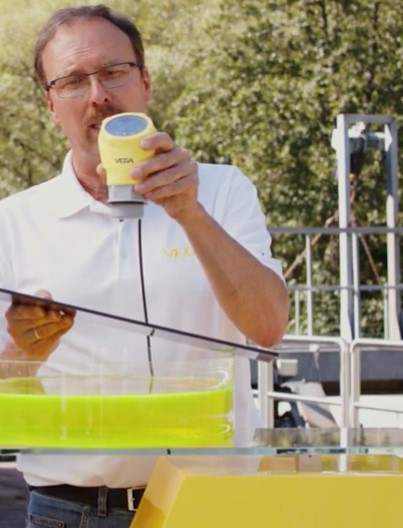
Jürgen Skowaisa demonstrates how a radar sensor can measure level through the plastic material of a typical container. |
Measuring through container walls
Radar sensors can also make a measurement through the walls of a plastic container. The microwave radar signals pass right through the plastic sheeting, allowing the sensor to measure the liquid surface with no direct physical contact with the medium. This is, of course, ideal for aggressive media, because you do not have to worry if the sensor has high chemical resistance or not. This article was adapted from an episode of VEGA Talk “Radar vs. Ultrasonic,” a YouTube video series from VEGA.
Subscribe to VEGA’s YouTube channel to never miss an episode. This article comes from the January 2021 InTech Focus ebook.