This article was written by Ian Verhappen, PE, CAP, managing director of the ISA108 committee, and Herman Storey, co-chair of the ISA108 and ISA100 committees.
There are so many acronyms and so little understanding of what they mean. Not only do we have to interpret acronyms that are specific to our industry, the automation discipline, our companies, and what is perceived to be “common knowledge” across multiple sectors, but the expectation is that we do so consistently. These are tough tasks, for which this article will give you pause for thought and the impetus to contribute to the discussion, so we can standardize at least some of these concepts.
Unfortunately, even if we could agree on these definitions and their associated acronyms, the respective term would describe only a small part of the complete set of activities that encompass the full life cycle of configuration and system tools support, parts management, scheduling, maintenance activity, and follow-up, including determining why the maintenance is required. Fortunately, work is being done to help define how to do effective maintenance for intelligent field devices.
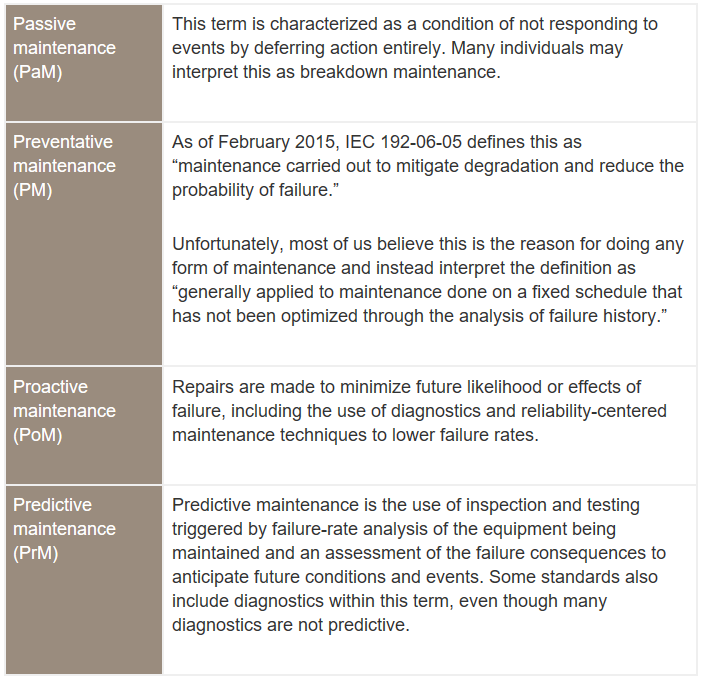
Consequently, the various life cycles must also be coordinated, as the IDM program must coordinate with other elements of the business and control systems. There are many other standards-related activities within ISA, the IEC, and the International Organization for Standardization that exist or are in development to identify and bridge the “gaps” between not only the various systems, but also between the associated work practices to execute the tasks necessary to support intelligent devices throughout their life cycles. Your PM program may be passive, preventative, predictive, proactive, or something else entirely, but regardless of the name, it represents but one part, although an important one, of the full life cycle of your automation system and facility.
About the Author
Ian Verhappen, P.Eng., CAP, is a senior project manager at CIMA+ where he specializes in industrial communications networks, including Foundation Fieldbus technology; control system migrations/upgrades; process analyzers; sample systems; and oil sands automation. Ian, an ISA Fellow, has been involved in digital communications since 1994. He helped to install the first multi-vendor Foundation Fieldbus project in 1996.
Since then, he has served as both a project engineer/designer and an external review consultant for a number of companies in pulp and paper, mining, food processing, water and wastewater, oil sands processing, petrochemical and refining industries. Ian is an active ISA volunteer leader, serving as Vice-President of ISA Standards and Practices and a former ISA District 10 Vice President. As a leader in automation practices, he has worked closely with the Standards Council of Canada and the International Electrotechnical Commission (IEC). He currently serves as Canadian Chair of IEC TC65, SC65B and SC65E. He is co-author of several ISA books, including A Guide to the Automation Body of Knowledge and Foundation Fieldbus .
An inductee into the Process Automation Hall of Fame, Ian earned a bachelor of science degree in environmental science and a bachelor of chemical engineering degree, both from the University of Alberta.
Connect with Ian


About the Author
Herman Storey is co-chair of the ISA108 and ISA100 committees. He is chief technology officer of HE Storey Consulting based in Kingwood, Tex.
Connect with Herman
A version of this article also was published at InTech magazine.