This post is an excerpt from the journal ISA Transactions. All ISA Transactions articles are free to ISA members, or can be purchased from Elsevier Press.
Abstract:
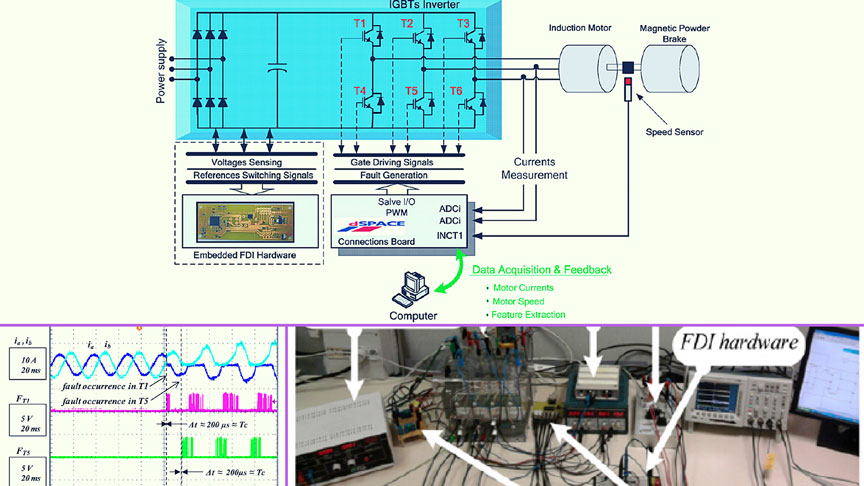
This paper deals with a fault detection technique for insulated-gate bipolar transistors (IGBTs) open-circuit faults in voltage source inverter (VSI)-fed induction motor drives. The novelty of this idea consists in analyzing the pulse-width modulation (PWM) switching signals and the line-to-line voltage levels during the switching times, under both healthy and faulty operating conditions. The proposed method requires line-to-line voltage measurement, which provides information about switching states and is not affected by the load. The fault diagnosis scheme is achieved using simple hardware and can be included in the existing inverter system without any difficulty.
In addition, it allows not only accurate single and multiple faults diagnosis but also minimization of the fault detection time to a maximum of one switching period (). Simulated and experimental results on a 3-kW squirrel-cage induction motor drive are displayed to validate the feasibility and the effectiveness of the proposed strategy.
Free Bonus! To read the full version of this ISA Transactions article, click here.
Join ISA and get free access to all ISA Transactions articles as well as a wealth of other technical content, plus discounts on events, webinars, training & education courses, and professional certification.
Click here to join ... learn, advance, succeed!
2006-2017 Elsevier Science Ltd. All rights reserved.