While COVID-19 has accelerated developments in smart buildings, these building trends and innovations will move in new directions post-COVID.
With COVID, the primary focus of smart building innovations and transformations has been infection containment and social distancing, where empty spaces have become necessary with alternate seats and expanded waiting lines. Work hours have also become more staggered, requiring heating, ventilation, and air conditioning (HVAC) systems to run for longer hours.
{% video_player "embed_player" overrideable=False, type='scriptV4', hide_playlist=True, viral_sharing=False, embed_button=False, autoplay=False, hidden_controls=False, loop=False, muted=False, full_width=False, width='1280', height='960', player_id='35586967782', style='' %}
Video courtesy of prxd; music courtesy of Bensounds
In this article, I will talk about how we can utilize these innovations to go beyond infection containment and make this transformation sustainable. Investment in these technologies can be leveraged to create new services, experiences, and value—limited only by our imagination. For example, employee and visitor productivity apps can enhance every conceivable function: from entry and exit to wayfinding, communications, and more. The diagram below shows how we can enhance the visitor experience in a COVID-free smart building of the future.
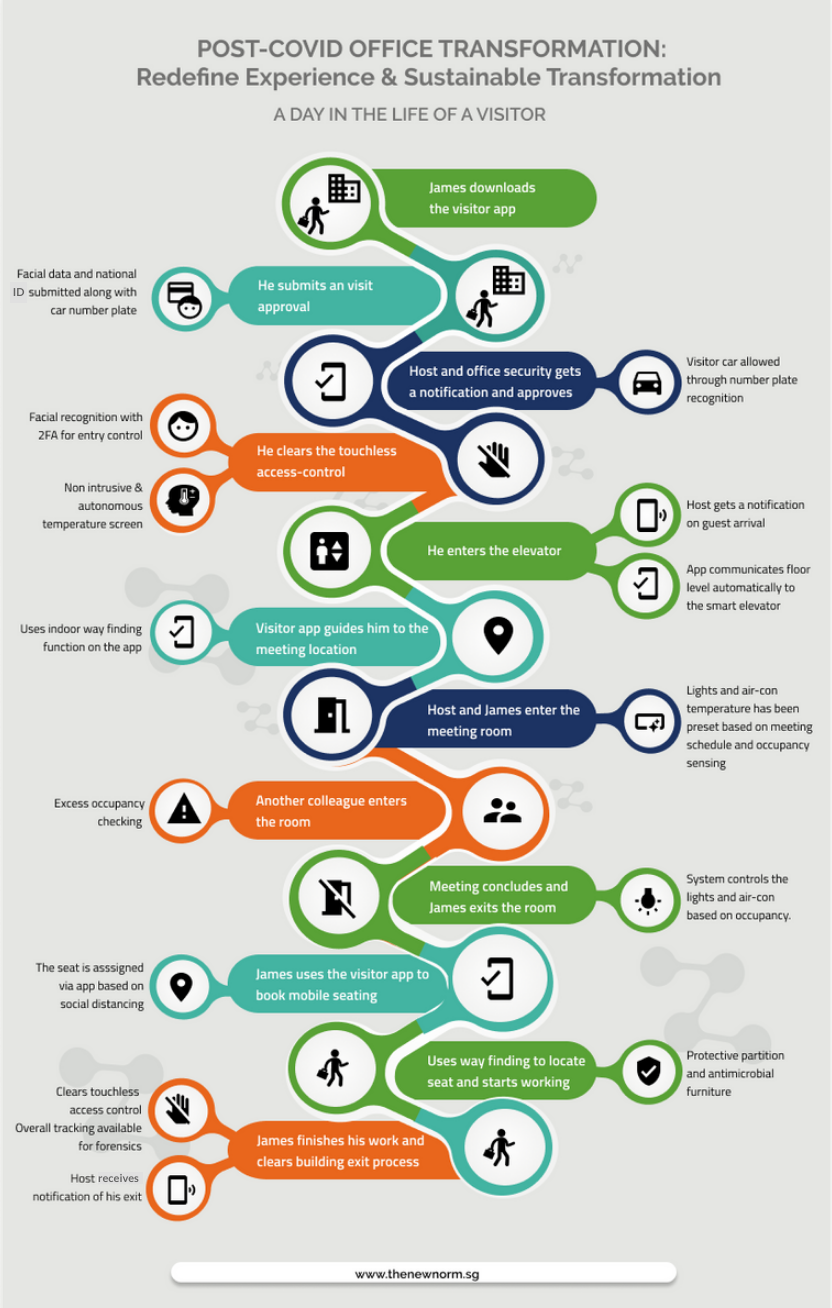 Infographic by Vinod Bijlani, courtesy ofwww.thenewnorm.sg
James Visits a Business Partner
James’s visit begins when he downloads the
visitor mobile app
provided by his business partner. Using the app, he requests for a visit and provides his facial information and national identification, along with his car license plate information.
The security agency, the company’s business partner, reviews this information and approves his request. The request goes to the business partner host who checks his availability and approves James’s request.
Having completed the necessary security checks, James experiences a seamless entry on the day of his visit. He drives to the car park at his business partner’s office and is allowed to enter, as the numbers on his license plate are recognized by the
video analytics
solution implemented at the parking entrance. He then enters the office through a
touchless access control
which recognizes him via his facial information. The system also checks whether he has a fever and is wearing a mask. Once he is cleared to enter the office, the host is notified that James has arrived.
These first four steps of James’s visit were implemented for infection containment, but they can be used to
completely automate the visitor entry process
and save around one hour of combined productive time for the visitor and host. James walks to the elevator and the visitor app communicates with the smart elevator, relaying the floor on which his meeting will be held. He reaches the floor without touching any buttons. He then uses the
wayfinding feature
in the app to locate the meeting room.
The meeting lights have been brightened and the air-con temperature has been set to a comfortable level before James and his host enter the meeting room. Inside the room, data from
video-based solutions
is fused with information from
occupancy sensors
to ensure social distancing and occupancy compliance with regulations.
The meeting concludes and the participants leave the meeting room. Automatically, the lights are dimmed and the air-con shut off by the
smart building system
.
After the meeting, James plans to continue working at the business partner’s office. He uses the visitor app to request a
mobile seat
. The system checks for availability based on social distancing norms and assigns a seat for him for the requested duration. He uses the wayfinding app to walk to the assigned mobile seat. When he finishes his work and decides to leave the office, he passes through the contactless exit where his facial data is captured and temperature is logged. The host is notified that his guest has left the building.
Once again, technologies such as wayfinding, mobile seating, automatic lights, and air conditioning controls—originally deployed for social distancing detection—can now be used to ensure a seamless visitor experience. They can also improve visitor productivity and enhance the employee experience in a smart building, making for a sustainable transformation.
Transforming with a Staged Approach
A digital transformation of such scale would best be implemented in organized stages and according to priority. In the diagram below, I have summarized the five stages of smart building implementation, from managing touchless entry to social distancing, energy conservation, occupancy management, and experience redefinition.
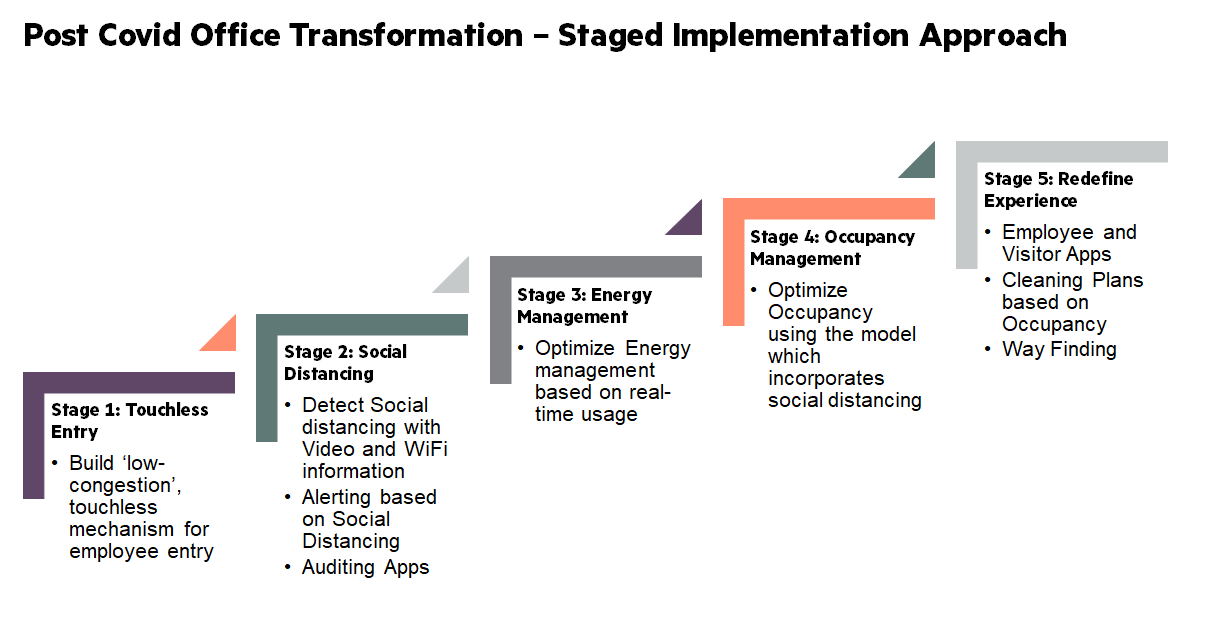 Infographic by Vinod Bijlani, courtesy ofwww.thenewnorm.sg
The valuable lessons gleaned from the current pandemic can serve to prepare and protect us from future ones. Should another pandemic or natural disaster occur in the next five, 10, or 15 years, smart and resilient buildings and cities will ensure that we are ready to defend ourselves with utmost sophistication and order. This will greatly minimize the impact on our economy and daily life, as compared to the current chain of detrimental effects we see rippling through 2020 and beyond.
Interested in reading more articles like this? Subscribe to ISA Interchange and receive weekly emails with links to our latest interviews, news, thought leadership, tips, and more from the automation industry.