-

 ISA provides technical resources and standards to help industrial automation professionals advance their careers and the field. We enable automation professionals worldwide to solve problems and enhance their skills by bringing people together to create new technologies and share best practices with future automation professionals.
-
ISA Resources
-
Upcoming Events
-
Industry Insights
-
Consortia
-




Articles and News
15 Results Found
-

The Eight Types of Data Context
Without context, manufacturing data is worthless. Here's what to consider to turn digital junkyards into gold nugget insights. -

AI Will Fail Manufacturers in 2025
Empowering the controls team with time-series data from automated machines means you are moving forward on a digitization journey. -

The Crucial Role of Data Conditioning in Smart Manufacturing
Without addressing the diverse and complex nature of data—whether it comes from different equipment standards or varying measurement formats—the full potential of Smart Manufacturing cannot be realized. -

Manufacturing Automation ROI is Tragically Undervalued by Small and Medium Manufacturing Companies
Most manufactures are incorrectly calculating their ROI. This is because they are only considering the most basic values of automation investment. -

Four Huge Potholes on the Road to Manufacturing’s Digital Transformation!
The Road to Digital Transformation isn’t a superhighway; it is rough with unexpected twists and turns. You’ll want to use your old pickup and not your new Tesla. -

How Does DH+ Compare to Ethernet?
Because DH+ is many years older than Ethernet, it's not not nearly as fast, sophisticated or flexible. However, it supported the manufacturing applications of its time very well. -
Five Recommendations for Reliable EtherNet/IP Control Systems
The search for reliable, practical information on building EtherNet/IP subnetworks on Ethernet for factory floor manufacturing systems is over. This article was originally published in the Automation 2021: Control Systems Ebook. -
Real Time Automation Announces Release of John S. Rinaldi's Book: The Everyman's Guide to EtherNet/IP: The Industry's Leading Automation Protocol
"It's the story of how and why EtherNet/IP was conceived and its rise to dominance in the automation world. It's also a real-world, hands-on handbook for the technology and how it relates to other technologies like Modbus TCP, PROFINET IO and the rest‚" says Rinaldi. -
How Microsoft Is Leveraging OPC UA to Get an Irreplaceable Position in Your Factory
By John Rinaldi, Real Time Automation In their latest series of announcements, it’s clear that OPC UA is key to Microsoft’s strategy of entering and dominating the factory floor through its Azure cloud services. -
Why Modbus still matters book
Modbus book explains why this 40-year-old technology still matters. -
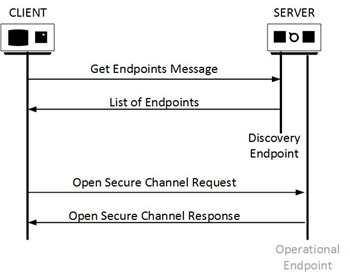
How OPC UA Clients Discover Servers (Part 2)
By John Renaldi, Real Time Automation OPC UA Discovery has a very flexible and sophisticated mechanism for Client devices to find and identify Server devices. This article is the second of two articles that explain that how OPC UA Device Discovery works. -
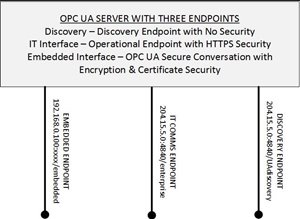
How OPC UA Clients Discover Servers (Part 3)
OPC UA created a more robust and flexible mechanism that works equally well on the factory floor with embedded devices as it does in the Enterprise with IT devices. This article is the first of two articles that explain that how OPC UA Device Discovery works. -
OPC UA as the bridge to the enterprise
By John Rinaldi, Real Time Automation Because of the discontinuity between the factory floor and the Enterprise, opportunities to mine the factory floor for quality data, interrogate and build databases of maintenance data, feed dashboard reporting systems, gather historical data and feed enterprise analytic systems are lost. But there is a reliable, highly secure and reliable solution. -
Mining Manufacturing Data - Leveraging Trapped Data for Results
By John Rinaldi Investing in new control and automation systems is an expensive and disruptive activity, particularly when the majority of the data is already instrumented and sitting in controllers, drives, sensors and other devices in the plant. There is a far more cost effective and non-disruptive way to acquire and use the data trapped on the plant floor. -
Real Time Automation Gateways meet UUKL Smoke Certification
The products covered by UUKL are intended to be installed in conjunction with heating-ventilating-air conditioning (HVAC) equipment to form a system for controlling the flow of smoke in a building during a fire condition.


