-

 ISA provides technical resources and standards to help industrial automation professionals advance their careers and the field. We enable automation professionals worldwide to solve problems and enhance their skills by bringing people together to create new technologies and share best practices with future automation professionals.
-
ISA Resources
-
Upcoming Events
-
Industry Insights
-
Consortia
-




Search
22,757 Results Found
-
 Feature
Factors to Consider in Cabling a Reliable VFD System
A Variable Frequency Drive regulates the speed of a 3-phase AC electric motor by controlling the frequency and voltage of the power it delivers to the motor. Today, these devices are becoming prevalent in a wide range of applications throughout the industry, from motion control applications to ventilation systems and many others. -
News
ISA introduces three courses for automation and instrumentation technicians
Courses cover PLCs, electrical controls and instrument maintenance. -
Industry Product
Mitsubishi releases F800 Variable Frequency Drive
F800 Series is designed to efficiently move air in HVAC applications, including air handlers, cooling towers, and pumps. -
Industry Product
Belden expands line of variable frequency drive cables
IndustrialTuff Variable Frequency Drive (VFD) Cables, designed to carry power from AC drive systems to AC motors, now includes four new 10 to 16 AWG, 600V UL 1277 cables incorporating a signal pair for brake applications. The cables feature an overall Beldfoil shield plus 85 percent TC braid shield for highly effective radiated and conducted noise protection. -
Industry Product
ABB introduced ACH580 series of variable frequency drives
ACH580 VFDs are integrated with ABB Ability monitoring services – ABB’s cross-industry, digital offering, which provides real-time data about drive status and performance from any location. Monitoring parameters include drives availability, environmental conditions and fault events. -
News
HANNOVER MESSE covers sustainable efficiency
HANNOVER MESSE 2012, which runs from 23 to 27 April, provides an overview of all key resource-saving industrial technologies. -
 White Paper
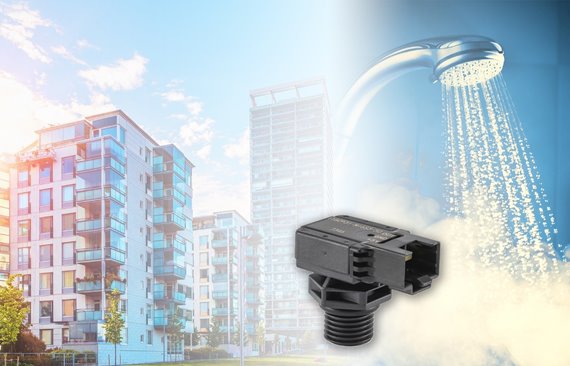
Improving the Efficiency and Reliability of Water Systems with Variable Speed Pumps and Pressure Sensors
Distributing water on a large scale has been a challenge that the world has tackled for decades. It is a particular challenge in high-rise buildings, and with a trend for designers to build up in urban areas, rather than out, it is a challenge that has become a new focus for design engineers. -
Industry Product
ABB announces E-Clipse Bypass back-up motor control
E-Clipse Bypass lets HVAC drives communicate directly with Building Automation Systems. -
 Feature
ISA Training and Education in July: Learn, Advance, Succeed
ISA Training and Education in July: Learn, Advance, Succeed -
 Feature
Consider the Big Picture When Justifying an Automation Project
To achieve a successful industrial automation project implementation, it’s important for everyone to be involved with the process. -
Industry Product
NUM introduces Flexium+ CNC for safe control of machine tools
Flexium+ comes with NUMSafe, which uses a Fail Safe over EtherCAT (FSoE) protocol to ensure integrity of all safety-related data. -

-
News
Danfoss expands in Illinois
Danfoss is doubling its Loves Park, IL, facility that produces variable frequency drives, adding both production and office space. -
Case Study
CP Automation helps enhance power capabilities for UK port
As part of a larger infrastructure investment, CP Automation recently installed a Riello 3/1 phase UPS system at 40 kVa at one bustling UK port to improve the duration of its power supply. -
Industry Product
Siemens Introduces New Line of Energy-efficient Industrial Motors
Offered in aluminum and cast iron frame configurations, these motors include high efficiency and industry-leading NEMA PremiumR efficient designs to help motor users lower energy costs and extend service life. A unique die cast copper rotor and special stator designs provide the added efficiency of these motors. -
 Feature
AutoQuiz: Why Must Voltage Be Reduced Along with Frequency in a Variable Frequency Speed Controller?
To maintain a constant (rated) flux density, the applied voltage must also be changed in the same proportion as the frequency (per Faraday’s law). -
 Feature
AutoQuiz: How to Calculate Rated Torque with Variable Frequency Drives
The volts per hertz ratio (V/Hz) controls the torque of a motor. As long as this ratio is in proportion with the nameplate rating, the motor will develop rated torque.


