AutoQuiz is edited by Joel Don, ISA's social media community manager.
This automation industry quiz question comes from the ISA Certified Control Systems Technician (CCST) program . Certified Control System Technicians calibrate, document, troubleshoot, and repair/replace instrumentation for systems that measure and control level, temperature, pressure, flow, and other process variables. Click this link for more information about the CCST program.
A fluid is flowing through a 10-inch (0.254 m) diameter pipe at a velocity of 6 feet/sec (1.83 m/sec). When the pipe reduces to an 8-inch (0.2032 m) diameter, and all other flowing parameters remain the same, the fluid velocity becomes how many feet/sec (meters/sec).
a) 2.550 (0.77724) b) 6.075 (1.85166) c) 9.375 (2.8575) d) 12.75 (3.8862) e) none of the above
The "constant" between the run of pipe that has a 10-inch diameter and the run of pipe with a diameter of 8 inches is that the flow rate (and other fluid properties) is the same in both pipe lengths.
Flow through a round pipe can be expressed as:
Q = Velocity (ft/sec) x Area of Pipe (ft2 / m2)
Since flow is constant between the two pipe sizes, we can set:
Velocity 1 x Area 1 = Velocity 2 x Area 2 ,
where the subscript = 1 for the initial conditions (10-inch pipe) and subscript = 2 for the final conditions (8-inch pipe).
Solving for Velocity2:
Velocity2 = Velocity1 x Area1 / Area2
For the 10-inch pipe, Area (in ft 2 ) = pi x D 2 / 4 = 0.5454 ft 2 . (Don't forget to divide 10 inches by 12 to get diameter in feet before "squaring.")
Metric
: A = pi x 0.2542 / 4 = 0.0506 m2
For the 8-inch pipe, Area (in ft 2 ) = pi x D 2 / 4 = 0.3490 ft 2
Metric
: A = pi x 0.20322 / 4 = 0.0324 m2
Substituting these values in the equation for Velocity2 above:
Velocity2 = Velocity1 x Area1 / Area2
Velocity2 = 6.0 ft/sec x 0.5454 / 0.3490 = 9.375 ft/sec
Metric
: V = 1.83 m/sec x 0.0506 / 0.0324 = 2.857 m/sec
The correct answer is C .
Reference
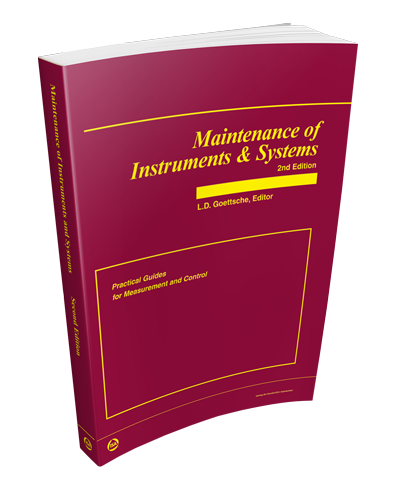
: Goettsche, L.D. (Editor), Maintenance of Instruments and Systems, 2nd Edition
About the Editor
Joel Don is the community manager for ISA and is an independent content marketing, social media and public relations consultant. Prior to his work in marketing and PR, Joel served as an editor for regional newspapers and national magazines throughout the U.S. He earned a master's degree from the Medill School at Northwestern University with a focus on science, engineering and biomedical marketing communications, and a bachelor of science degree from UC San Diego .
Connect with Joel