




Manufacturers operate in a much more complex environment than even a few years ago, and performance today depends less on the technology and so much more on how well it’s used across operations day after day, explained Andy Stump, director of technical enablement at Rockwell Automation, the world’s largest company dedicated to industrial automation and digital transformation.
Rockwell has recently released its 2026 State of Manufacturing Report, which indicates most manufacturing plants have moved their digital transformation plans from pilot to progress to beat compounding threats to success. Manufacturing has traditionally been a slow industry to evolve, but this year’s report shows that manufacturers are taking action.
Digital transformation is imperative
Nearly 90% of survey respondents indicated that digital transformation is now necessary for them to stay competitive. Only 18% of respondents said their plants are still in the pilot phase with smart manufacturing technologies, while 59% reported shifting from pilot to the action phase.
While past manufacturing reports identified a standout threat to manufacturing progress, this year’s report indicated several threats are compounding: cost, workforce shortages, cyber risk and supply chain disruptions. “Manufacturers are targeting digital transformation efforts as measurable outcomes to improve quality, reduce cost, reduce risk and improve OEE,” Stump explained.
Increased cybersecurity risk necessitates systems designed with resilience
As operations become more connected, the risk of exposure to cybersecurity schemes increases. Almost half of those surveyed said they experienced a cyber incident in the past year. Respondents called out integration points between IT and OT as the most vulnerable to cyber incidents today.
The report indicates that security is the prerequisite for autonomy. “What stands out in the data is that cybersecurity is no longer seen as a standalone issue,” Stump said. “It’s tied to operational performance. Resilience as an organization depends on building systems in a secure way from the beginning.”
Smart manufacturing is rewriting roles, skillsets and expectations
Manufacturing performance isn’t just about having advanced technology; it’s about how technology is applied. Part of that involves preparing people to use technology. Survey results show that manufacturing leaders see the need for reskilling because most organizations expect roles to continue to evolve. 40% of survey respondents said their workforce was reskilled last year.
“It’s not about using tech to reduce the workforce,” Stump said. “It’s about using tech to help people.”
Operational intelligence as a competitive advantage in manufacturing
Manufacturers have access to more data than ever, but only 43% of collected data is used effectively. The challenge is taking that data and turning it into action points that teams can apply consistently.
“AI is not just a buzzword. Manufacturers are finding ways to bring it into their facilities, put it to use and get those outcomes,” Stump said. “Those who turn data into action are becoming the winners in manufacturing.”
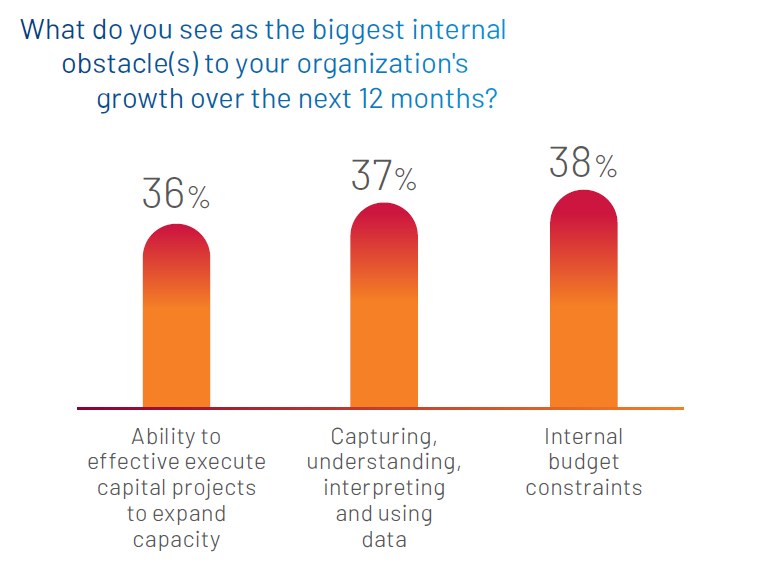 Figure 1: A chart in Rockwell Automation’s report shows that 37% of organizations say data implementation is a main internal obstacle to deal with in the next 12 months.
According to a 2025 Gardner Top Data and Analytics prediction, half of business decisions will be augmented or automated by AI agents for decision intelligence by 2027. According to Rockwell’s report, organizations are focusing on implementing solutions in their facilities that move data across the system, supporting decisions in real time.
“Organizations that emphasize their overall AI literacy, embracing and applying it, will see a 20% higher financial performance compared to those that do not,” Stump said.
The report offers eight steps to drive value and achieve success: 1) prove value vs. technology, 2) invest with a short-term payback, 3) plan for scalability, 4) foster enterprise collaboration, 5) learn, iterate and improve, 6) communicate progress and success, 7) define and apply governance and 8) equip and champion people. See the full report for details.
Rockwell Automation Chairman and CEO Blake Moret said, “Integrated technology, paired with empowered people, isn’t just an advantage; it’s the defining characteristic of industry leadership.”
About Rockwell Automation’s State of Manufacturing Report 2026
The Rockwell Automation 2026 State of Manufacturing Report includes data from more than 1,500 manufacturing leaders spanning several manufacturing industries across 17 countries. 62% of survey respondents were decision-makers, an increase from last year. The full report covers five main areas: 1) how digital transformation is playing out in practice, 2) how AI is being used inside operations, 3) how operational intelligence is becoming a competitive advantage for manufacturing, 4) how manufacturers themselves are responding to rising cybersecurity risks around the globe and 5) how the workforce is changing in response to that.