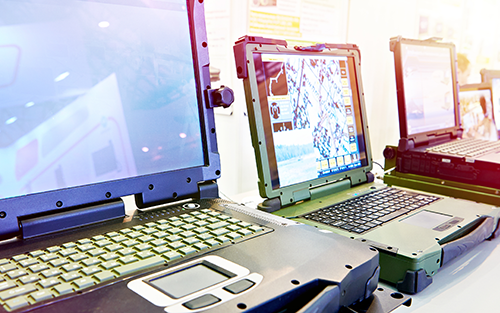
Mass-produced commercial PC systems have improved in quality and longevity over the last two decades, especially in the case of “business-grade” office systems. Many companies are familiar with these business-grade PC offerings. With lifespans of three to five years, they are more robust than “consumer-grade” PCs found at the big-box stores that may only last one to three years. Despite this increased hardware quality, even business-grade PCs can be a liability in a digitized industrial environment. Industrial digitalization requires the assurance that hardware can support mission-critical functions and operate reliably long term.
Industrial environments subject computing systems to extreme temperatures, humidity, dust, vibrations and potentially corrosive substances, which can significantly shorten the life of standard office PCs. Industrial operations rely on continuous, 24/7 uptime for monitoring and control processes. Downtime or frequent equipment replacement in these critical settings can lead to substantial financial losses and safety risks. As a result, industrial computers are engineered explicitly for ruggedness, durability and extended life cycles to ensure they can endure these conditions and maintain reliable performance over many years, making them essential for industrial applications.
Industrial applications demand capable hardware
Industrial PCs (IPCs) serve critical roles in environments where standard commercial office PCs would fail to perform. IPCs are deployed on factory floors to control automation, monitor processes and manage machinery. And these ruggedized computing systems are designed to withstand harsh conditions and serve various industrial applications. This includes the ability to withstand extreme temperatures, moisture, vibration and dust, where a typical PC would not survive. The design philosophy for IPCs is to provide a controlled environment for the enclosed electronics to ensure consistent operations and a long hardware life despite the rigors associated with long operational hours and complex conditions.
In remote and harsh environments like drilling rigs, IPCs support real-time data analysis, monitoring and control systems. Their resistance to extreme temperatures and hazardous conditions is essential for these applications. IPCs are utilized for monitoring and controlling mining equipment, ensuring safety and optimizing operations in challenging underground or open-pit environments. IPCs in medical devices and equipment, including diagnostics, imaging and patient monitoring systems, are built to withstand sterilization procedures and operate reliably in critical healthcare settings. In military and aerospace applications, IPCs in navigation systems, avionics and rugged field computers withstand vibrations, shock and extreme temperatures.
IPCs are also crucial in controlling and monitoring traffic management systems, railway signaling and rugged in-vehicle computers in transportation sectors, enduring challenging weather conditions and vibrations. In these and other demanding environments, IPCs offer reliability, durability and robust performance, making them indispensable, where standard office PCs would falter or quickly degrade. IPCs provide higher performance, quality, reliability, compatibility, customization options and long-term sustainability, especially in the demanding digital factory environment.
More power, more problems
One of the main drivers of digital adoption and the requirement for expanded PC processing power and memory on the factory floor is advanced automation, machine learning and simulation. The advent of technologies that decrease costs, increase efficiency, streamline maintenance and reduce downtimes has come with a massive demand for computing power, on-site and on-demand. This advanced computing power has often been added through expansion ports in PC motherboards, using consumer and commercial Graphics Processing Unit (GPU) expansion cards that offer substantial RAM and CPU processing, traditionally used to render high-fidelity graphics for games and the animation industry.
GPU expansion cards have also found a home in powering cryptocurrency, machine learning, simulation and augmented reality applications. Acquiring consumer GPUs for advanced computing needs in industry has become a formidable challenge. The unprecedented demand from not only gamers but also cryptocurrency miners, data scientists and more has created severe shortages. This scarcity not only drives up prices but also exacerbates the logistical difficulties in procurement. Industries reliant on GPUs for tasks like artificial intelligence, simulation and data analysis face delays, hindering innovation and productivity.
Additionally, the compatibility of consumer GPUs can sometimes be problematic, and the quality control leaves much to be desired. Organizations can opt for expensive professional GPUs, which offer more reliability but also face supply constraints. The struggle to secure these critical components underscores the need for long-term planning by companies that need the ability to scale operations on demand, not on the backordered schedule of a hardware vendor.
Bespoke IPCs perform and scale
When developing new machines or adding capabilities to existing lines that require additional computing power, manufacturers and other industrial settings should look to application-designed IPC solutions. IPC vendors offer much higher standard capabilities than commercial systems, with memory and processing that can be customized for your application. IPC vendors focusing on quality use X-ray inspection to validate the component quality and install your IPC parts only after rigorous stress testing to ensure their lifetime. Some IPC vendors have direct relationships for advanced GPU processing hardware, which means you have a direct pipeline to the advanced computational power you need for machine learning, without dealing with the public supply-chain backlogs.
Instead of being delivered as boxes of parts for assembly and testing on-site, with uncertain results, IPC systems come fully assembled, tested and ready to install, reducing machine startup costs and time. IPC solutions offer clear advantages over business-grade PCs in industrial environments. They are rugged and designed to withstand harsh conditions, such as extreme temperatures, vibrations and dust. IPCs also have the quality control to ensure longevity and reliability, delivering the uninterrupted operations critical in manufacturing and automation settings. These specialized systems are tailored to meet the specific needs of industrial processes, making them a superior choice for stability and performance.